Don't Buy the Box Thick Clicky Navy Until You Read This Full Analysis
Introduction
The Box Thick Clicky Navy is a switch that often appears in conversations among mechanical keyboard enthusiasts, typists, and a growing number of gamers seeking a pronounced audible and tactile experience. It promises a satisfyingly loud click and a strong tactile bump that feels decisive under the finger—qualities that attract people who type for hours and enjoy mechanical feedback. But loud and tactile does not automatically mean better for every user or every use case. This article provides a thorough, practical analysis of the Box Thick Clicky Navy: what it actually feels and sounds like, who will benefit from it, common pitfalls and mods, and how it compares to other popular clicky switches.
What is the Box Thick Clicky Navy?
The Box Thick Clicky Navy belongs to the family of "box" style mechanical switches. The term "box" refers to a reinforced housing around the stem designed to reduce wobble and improve dust/water resistance compared with older open-top designs. The "Navy" designation typically signals a clicky, heavy-feeling switch with a noticeable tactile event and a distinct audible click. The "Thick" descriptor indicates a heavier or more solid-sounding variant—often due to housing geometry, thicker plastic, or the inclusion of a click bar instead of a click jacket.
In real-world usage, Box Thick Clicky Navies are chosen for their presence: they announce each keypress in a way that is unmistakable. That quality makes them appealing for many typists but problematic in shared or quiet environments.
Detailed Review and Analysis
Build and Physical Characteristics
Physically, Box Thick Clicky Navies are typically built with a reinforced shell—two-piece housings where the top has an inner "box" around the cross-shaped stem. This improves stability and reduces side-to-side wobble. The click is generated either by a click bar integrated into the housing or by a click mechanism on the stem; the exact construction can vary by batch or maker, which is something buyers should be aware of.
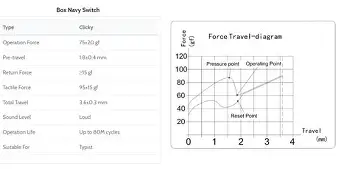
Springs and stem tolerances often come into play: many users report that Navy variants feel "heavier" than classic clicky switches. That weight comes from a stiffer spring, a deeper tactile bump design, and the force required to trigger the click mechanism. The net effect is a switch that demands a deliberate push—rewarding typists who like to press with authority but tiring for users who favor light, fast keystrokes.
Sound Profile
The Box Thick Clicky Navy typically produces a low-to-mid pitched click with a fuller body than the thin, high-pitched Snap of some older clicky switches. Because of the thick housing and often bulkier internals, the sound is less “sharp” and more “thocky” or rounded, though still clearly clicky. Housing material, keyboard case, plate material, keycap thickness, and even desk surface significantly influence the final sound. Users can tune the character from very loud and bright to more tempered by using dampening foam, switch films, and choosing different keycaps.
Typing Feel
On the finger, Navies present a pronounced tactile step accompanied by an audible click precisely at or near the actuation point, depending on the variant. That combination is highly satisfying to users who appreciate clear feedback for each press—writers, coders, data entry professionals, and anyone who likes to know exactly when each key was registered. For fast-paced gaming, however, the heavier actuation and strong tactile reset may slightly slow double-taps and key repeats compared to lighter linear or lighter tactile switches.
Durability and Reliability
Box-style switches are generally more robust than older designs due to the boxed stem reducing debris ingress and improving mechanical life. Like many modern mechanical switches, these are designed to endure tens of millions of actuations. Still, quality control can vary by manufacturer and production run. Buyers should expect small batch differences—some units may exhibit crisper clicks or minor wobble compared to others. If bulk consistency is critical (e.g., for a custom keyboard project), sourcing from a reputable distributor or ordering a sample pack first is sensible.
Shop the latest Electronics picks on Amazon.
Browse Now →Modifiability
Many enthusiasts apply switch films, spring swaps, or partial lubrication to refine feel and sound. Important: lubricating a click mechanism will often soften or destroy the click, so lubrication should be applied carefully and usually only to the slider rails—not to the click bar or click jacket. Switch films (thin inserts between top and bottom housing) and plate material changes (aluminum vs brass vs polycarbonate) can transform the sound signature dramatically without sacrificing the clicky nature.
Pros & Cons
- Pros:
- Bold, decisive tactile feedback that many typists find extremely satisfying
- Distinct audible click with a fuller, thicker tone compared to some classic clickies
- Box-style housing reduces wobble and improves perceived build quality
- Good candidate for sound-tuning through foam, films, and keycap choices
- Durable design intended for long-term use
- Cons:
- Very loud—unsuitable for open offices, shared workspaces, or live streams without mitigation
- Heavier actuation can be fatiguing for long gaming sessions or for users who prefer light switches
- Lubrication risks destroying the click mechanism if applied incorrectly
- Batch-to-batch consistency can vary between manufacturers
- Not ideal for high-frequency double-tap gaming due to tactile drag/reset feel
Comparison Table
| Feature | Box Thick Clicky Navy | Cherry MX Blue | Kailh Box Jade (example alternative) |
|---|---|---|---|
| Sound Profile | Full-bodied, thick click; deeper than classic blue | Bright, high-pitched click | Sharp, very audible click with slightly higher pitch |
| Tactility | Strong, pronounced tactile bump | Moderate tactile bump | Very strong tactile bump, similar or slightly different than Navy |
| Actuation Weight (relative) | Heavier than MX Blue (requires deliberate press) | Lighter to moderate (typist-friendly) | Often comparable to Navy or slightly heavier |
| Best For | Typists, writers, people who like loud, confident feedback | Typists wanting classic clicky feel | Enthusiasts seeking very bold click with minimal wobble |
| Modding Sensitivity | Click sensitive—lubing can mute click; films, foam recommended | Moderately mod-friendly | Similar—modding changes tone significantly |
| Stem Compatibility | Cherry MX cross compatible | Cherry MX cross compatible | Cherry MX cross compatible |
Real-World Use Cases
Understanding where Box Thick Clicky Navies excel and where they fall short helps match them to the right buyer.
Great For
- Writers and Editors: Professionals who type for hours and appreciate unmistakeable feedback at each keystroke will enjoy the satisfying click and tactile certainty.
- Programmers and Developers: Developers who favor deliberate, error-confirming keystrokes—especially for code typing where accuracy is valued—often find these switches comfortable.
- Home Office Setups (private): When noise is not an issue, the switch’s sound can be part of a pleasant home typing experience.
- Switch Sound Enthusiasts: People who build custom keyboards and experiment with dampening and films will find a lot of tuning potential in Navies.
Not Ideal For
- Shared Open Offices: The audible click can be disruptive to coworkers and may create friction in shared environments.
- Streamers/Call-Heavy Roles: Unless the keyboard is sound-dampened and the microphone setup accounts for it, the clicks will come through clearly on a live mic.
- Competitive Gamers who Rely on Rapid Repeats: Heavier, clicky switches may feel slower for quick double-taps or repeated rapid inputs compared to light linears.
Buying Guide: What to Consider Before Purchasing
Before committing to Box Thick Clicky Navy switches—especially when buying 60–100 units for a full keyboard—consider the following practical points.
1. Try Before You Buy
Switch feel and sound are highly subjective. If possible, test a single switch or a switch sampler with a plate-mounted tester. Many local meetups, keyboard groups, or friends in the hobby will have testers available.
2. Environment and Noise Tolerance
Assess where the keyboard will live. If work or home environments require quiet, plan for dampening strategies or choose a quieter switch. If working in private, the loud, bold click can be a positive attribute.
3. Quantity and Consistency
When building a keyboard, buyers often source a full set. Check seller reviews and batch consistency reports. If a uniform sound across all keys matters, buying from a single known batch or verified vendor reduces surprises.
4. Modding and Tuning
Decide whether to tune the switches. To preserve the click mechanism, avoid lubing the click components. Instead, use switch films, keyboard sound-dampening foam, and thicker keycaps to tune the sound without removing clickiness. If a softer feel is required, consider swapping springs rather than lubing the click mechanisms.
5. Compatibility
Verify the switches are compatible with the intended keyboard plate and PCB. Box-style switches usually come in both plate-mounted and PCB-mounted variants—confirm the seller’s description. Also ensure keycap profile and stem fit (Cherry MX cross standard generally applies).
Looking for the best Electronics deals on Amazon?
View Offers →6. Intended Usage
Match the switch to primary use: typing-first users often love the Navy; mixed-use (typing and gaming) users should weigh the heavier actuation; gamers focusing entirely on high-speed action may prefer lighter linears.
7. Return Policy and Warranty
Because feel and sound are subjective, check the return policy and warranty. Good vendors allow sample returns or provide clear terms for defective or inconsistent lots.
Tuning Tips and Common Mistakes
Some practical steps and pitfalls to be mindful of when tuning or using Box Thick Clicky Navies:
- Do not lightly lube the click mechanism. Lube will dampen or eliminate the click. If a softer sound is desired, use housing foams, dampening mats in the case, or thicker keycaps.
- Use films for a tighter sound. Thin switch films between top and bottom housings reduce rattle and produce a more focused click.
- Try spring swaps before heavy mods. Altering spring weight can balance fatigue and responsiveness without attacking the click mechanism.
- Beware of inconsistent batches. If multiple batches are mixed, expect slight tonal and feel differences across the keys.
- Test stabilizers and keycap fit. Larger keys like spacebar, shift, and enter will shape the overall typing sound; quality stabilizers make a larger difference than subtle switch variances for these keys.
Final Verdict
The Box Thick Clicky Navy is a compelling choice for a particular segment of users: those who prioritize bold tactile feedback and a substantial, characterful click. It excels at turning typing into a tactile and auditory experience. However, its strengths are simultaneously its weaknesses. The pronounced noise and heavier actuation make it less versatile than lighter, quieter switches. For somebody building a keyboard for a shared office, live streaming, or high-speed gaming, this switch may create more problems than satisfaction.
Buyers are advised to test a sample, think carefully about the environment where the keyboard will be used, and plan for sound-tuning if the raw click is too aggressive. For dedicated typists and custom keyboard hobbyists who enjoy modding and who have control over their acoustic environment, the Box Thick Clicky Navy can deliver a uniquely satisfying, confident typing experience.
Conclusion
In summary, the Box Thick Clicky Navy is not a one-size-fits-all upgrade. It rewards users who appreciate strong tactile and auditory feedback and punishes those who need discretion, speed, or a lightweight touch. Reading this analysis before purchasing helps align expectations: if a loud, pronounced click and a solid tactile bump are exactly what the buyer wants, Navies can be an exceptional choice. If the buyer is unsure, the sensible route is to test a switch in person or begin with a small sample to avoid a costly mismatch between expectation and daily reality.