I Switched to the Acemagic K1 Mini Pc and Here is What Happened
Category: Laptops
Introduction
Small-form-factor desktop machines have evolved from niche curiosities to practical daily drivers. The Acemagic K1 Mini PC is one of the newer entrants that promises a compact footprint, modern connectivity and enough performance for most everyday tasks. This article documents a practical, hands-on switch to the K1: the decision drivers, the real‑world behavior for different workflows, and guidance for potential buyers. The goal is an honest, useful editorial assessment that focuses on what buyers typically care about—performance, ports, upgradeability, thermals, noise, and value—rather than marketing blurbs.
Why consider a mini PC?
Mini PCs appeal to people who want a desktop-class experience in a small package. Common motivations include saving desk space, building a tidy home office, driving dual or triple displays for productivity, assembling a low-profile media center, or deploying compact workstations for point‑of‑sale and digital signage. Before switching to the Acemagic K1, those same considerations applied: the aim was to replace a bulky tower with something quiet, energy‑efficient and easy to tuck behind a monitor or under a TV.
First impressions and build quality
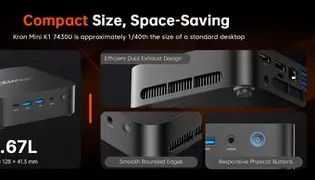
The initial unboxing and setup process sets expectations. The K1's chassis is compact, which makes it quick to position and connect. The unit tested felt well-constructed for its price bracket: panels fit tightly, no obvious flex, and the finish avoided fingerprints. Acemagic tends to aim at a balance of style and function—compact matte surfaces, a modest set of status LEDs, and mounting options that work behind monitors or on a shelf.
Setup is straightforward: attach a VESA bracket if needed, plug in power, connect displays and peripherals, and install storage and memory if one chooses to upgrade. The K1 is designed to be accessible to users who want to tweak RAM and storage later—something that many buyers care about because it prolongs the device’s useful life.
Performance and everyday use
Performance is the most consequential area for users. The K1’s real-world responsiveness depends heavily on the configuration chosen (CPU tier, amount of RAM, and type of storage). In daily office work—web browsing with many tabs, document editing, spreadsheets, videoconferencing, and running an email client—the K1 delivers a smooth experience when equipped with ample RAM and an NVMe SSD. Web apps like Google Workspace and collaboration tools such as Slack and Teams run without frustrating lag.
For media consumption—streaming 4K video, playing local high-bitrate files, or acting as the core of an HTPC—the K1 handles hardware-accelerated codecs effectively. When driving multiple displays (two or more), the device maintained steady playback and desktop performance, provided the chosen CPU/GPU tier supports multi‑display outputs at the needed resolutions.
Content-creation workloads show the limits and strengths of a mini PC. Light photo editing, casual video trimming, and audio production are feasible on the K1 with mid-range configurations. Heavier tasks—full‑length 4K video editing timelines, large RAW image catalogs with complex local adjustments, or sustained high-load compilation tasks—push the K1 into a longer rendering and export time compared with full-size workstations. In short, the K1 is excellent for everyday productivity and media tasks; creators with heavy, sustained workloads may prefer a higher‑end desktop or workstation.
Thermals and noise
Thermal management in small chassis is always a design compromise. In typical light-to-moderate desktop use, the K1 runs cool and quiet. Under sustained heavy CPU or GPU load, thermal throttling can become a factor depending on the configuration and ambient temperature. During extended compile jobs or benchmark-like workloads, the fan ramps up more noticeably than in idle, but it stays within tolerable levels for a desk environment. Buyers who prioritise near-silent operation should plan for configurations with conservative CPU choices or look into where the device will be placed (e.g., under a desk vs. next to the keyboard).
Looking for the best Laptops & Computers deals on Amazon?
See Deals →Ports and connectivity
One of the K1’s strengths is its attention to modern connectivity. Expect a mix of full‑size USB-A ports for legacy peripherals, USB-C (often with DisplayPort or power-delivery support), HDMI (or mini/DisplayPort variants) for displays, and a wired Ethernet jack for stable network connections. Built-in Wi‑Fi and Bluetooth functionality meet the needs of wireless peripherals and fast internet use. The actual port mix varies by SKU, so buyers should confirm the exact I/O layout when ordering.
Having a full complement of ports simplifies a tidy workspace: external drives, docking stations, wired keyboards and mice, and printers can all remain permanently connected. Support for multiple display outputs is especially important for productivity setups, and the K1 hits this mark for many configurations.
Storage, memory and upgradeability
Unlike many ultra-portable devices, the K1 typically offers user-accessible upgrade paths. Most configurations allow swapping or adding an M.2 NVMe SSD and increasing RAM up to the device’s supported maximum. Buyers who plan to keep the machine for several years should consider populating it with more RAM at purchase, since RAM is often the most impactful upgrade for multitasking and future-proofing.
Storage choices matter: an NVMe SSD substantially improves boot times, application launch speed and general responsiveness compared with SATA SSDs or HDDs. The K1 benefits from NVMe storage, especially when used as a daily driver with many browser tabs and cloud-syncing services active.
Software and operating system
Out of the box, the K1 typically ships with Windows preinstalled, but the hardware can also run Linux distributions if the user prefers. Compatibility is good for mainstream Linux distros, though buyers should verify driver support for Wi‑Fi and any proprietary components before committing to a non‑Windows setup. Software-wise, standard office suites, browsers and creative apps run without issue; licensing and activation are standard considerations when moving from one machine to another.
Real-world use cases
- Home office and remote work: The K1 is ideal for users who want a reliable, compact desktop for video calls, email, and productivity apps. Dual‑monitor support and wired Ethernet keep meetings stable and multitasking efficient.
- Media center / HTPC: Tucked behind a TV or in a media cabinet, the K1 streams high-definition content and supports local media libraries. Its small footprint and quiet idle operation make it suitable for living-room use.
- Light content creation: Casual photo editing, podcasting and short-form video editing work well on mid-range K1 configurations. Heavy content producers will find export times longer than on dedicated workstations.
- Education and labs: Schools and small labs can benefit from the K1’s space savings, easy management and upgradeability for classroom workstations.
- Digital signage and kiosks: The K1’s compact profile and reliable display outputs make it a practical choice for single-purpose deployments.
Comparison: How the Acemagic K1 stacks up
| Feature | Acemagic K1 | Typical Intel NUC | Typical Minisforum / Beelink |
|---|---|---|---|
| Form factor | Very compact, VESA-friendly | Compact, multiple chassis sizes | Compact to slightly larger depending on model |
| Configurability | Good — RAM/storage often user-upgradeable | High — many models designed for tinkering | Varies — many models offer M.2 and RAM access |
| Target user | Home office, HTPC, light creator | Enthusiasts, prosumers, compact workstations | General consumers, small business |
| Connectivity | Modern mix: USB-A, USB-C, HDMI, Ethernet | Typically rich port selection | Competitive: often includes USB-C and multi-display |
| Thermals & noise | Quiet at idle; audible under sustained load | Depends on model; fanless options exist | Varies by design; some prioritize silence |
| Value | Good value for compact productivity machines | Premium to high-end pricing for performance | Often competitive pricing with aggressive specs |
Pros & Cons
Pros
- Compact footprint that frees up desk space and fits behind monitors
- Modern connectivity suitable for most peripherals and displays
- User-friendly upgradeability for storage and memory
- Good day-to-day performance for productivity and media tasks
- Energy-efficient design compared with full-size desktops
Cons
- Thermals and sustained performance are limited by small chassis design
- Not optimized for heavy, long-running creative or compute workloads
- Fan noise rises under prolonged load in certain configurations
- Configuration and exact port layout vary by SKU—buyers must check specs carefully
- Warranty and after-sales support can vary by seller or region
Buying guide: How to choose the right K1 configuration
Choosing the right mini PC configuration involves matching hardware to expected workloads. The Acemagic K1 is a flexible base; the following checklist helps buyers get the most appropriate machine for their needs.
1. Define primary use cases
If the machine will primarily be used for web work, videoconferencing, and office apps, prioritize RAM (8–16GB minimum) and a fast NVMe SSD. For media center duties, confirm support for the video codecs and display resolutions required. For light content creation, target higher CPU tiers and 16GB+ of RAM.
2. Choose CPU and integrated graphics wisely
Mini PCs often rely on integrated graphics. That is sufficient for productivity and media playback. If occasional gaming or GPU‑accelerated workloads are important, look for the highest CPU/GPU tier available in the K1 lineup, but understand the limits—integrated graphics in a tiny chassis will not match discrete GPUs.
Shop the latest Laptops & Computers picks on Amazon.
View Offers →3. Prioritize RAM and storage
RAM is the most impactful upgrade for multitasking. For a comfortable experience, 16GB is a good baseline for power users; 8GB is acceptable for light use. An NVMe SSD as the primary drive makes the most noticeable difference in day‑to‑day responsiveness.
4. Verify ports and display support
Double-check the K1 SKU for the number and type of display outputs, USB ports, and whether a USB-C port supports DisplayPort or power delivery. Buyers with multiple monitors should confirm maximum supported resolutions and refresh rates when using all outputs simultaneously.
5. Pay attention to thermals and placement
Plan where the mini PC will live. Confining it to a narrow cabinet with limited airflow will worsen thermal throttling and noise. For quiet desktop setups, consider a modestly powered configuration and allow a few inches of clearance for ventilation.
6. Consider operating system and software needs
Confirm that the desired OS is supported and that drivers exist for all hardware components. If planning a Linux installation, check community reports about Wi‑Fi and Bluetooth driver support for the specific K1 hardware variant.
7. Warranty, after-sales and local support
Check warranty length and what it covers. If the device will be deployed in a business or critical home office role, local support and clear return policies reduce risk. If buying from third-party resellers, verify their return windows and service terms.
Maintenance, tips and practical notes
- Keep firmware up to date: BIOS and driver updates can improve stability, performance and compatibility. Check for official updates periodically.
- Use an SSD with good endurance: For workstations that perform frequent read/write operations, choose a reputable NVMe SSD with solid endurance ratings.
- Manage background apps: Mini PCs benefit particularly from lean software stacks—limit unnecessary background processes to keep thermals and responsiveness optimal.
- Positioning matters: Place the K1 where it can draw air without obstruction; avoid enclosed cabinets or piles of paper that trap heat.
- External storage for archives: Use external drives for large media archives to keep the internal drive free for OS and apps, which helps maintain snappy performance.
Conclusion
Switching to the Acemagic K1 Mini PC is a practical move for users who value a tidy desk, efficient everyday performance and modern connectivity in a small package. It excels at standard office work, remote meetings, web browsing, and media playback while remaining upgrade-friendly enough to extend its lifespan. The trade-offs are typical of small-form-factor systems: constrained thermals under sustained heavy loads and some variability across SKUs in port layouts and component choices.
For buyers whose primary needs are productivity, media consumption, and light creation tasks, the K1 is a compelling option that strikes a good balance between price, size and capability. Users with demanding, sustained compute workloads should weigh those needs against the K1’s design constraints or consider a more robust desktop or workstation instead. Overall, the K1 is a solid, versatile machine that makes a compelling case for replacing a bulky tower when desk real estate and quiet, efficient performance matter.