Is the Kindle Scribe Colorsoft 2025 Still Good in 2026? Long-Term Review
I've been using the Kindle Scribe Colorsoft 2025 for the better part of nine months now — carrying it between home, work, and travel — and I wanted to share a candid, long-term perspective. When I first bought it, the Colorsoft model promised a more colorful e-ink experience plus the familiar Scribe handwriting and reading workflow. After months of daily reading, heavy note-taking, PDF annotation, and a handful of sketching sessions, here's what I found: where it shines, where it falls short, and who I think should still consider it in 2026.
Quick verdict
In my experience, the Kindle Scribe Colorsoft 2025 is still a solid option in 2026 if your primary use cases are long-form reading and handwritten notes with occasional color reference. It’s excellent for reducing eye strain, for organizing annotated documents, and for students or professionals who want one device for books and notes. However, if you need true, punchy color for photo-accurate work, very fast refresh/interaction, or an app ecosystem, the Colorsoft’s color e-ink and software limitations will frustrate you.
What I tested and how I used it
My routine included daily reading (1–2 hours), meeting note-taking (handwritten notebooks), annotating research PDFs (some large files), a few casual sketches, and trying out the handwriting-to-text conversion for archiving notes. I also tested battery life under real usage — Wi-Fi on, sync to cloud enabled, regular page turns and stylus use — and I paid attention to software updates and how they changed the device behavior over time.
Design and build: familiar, refined, but not flawless
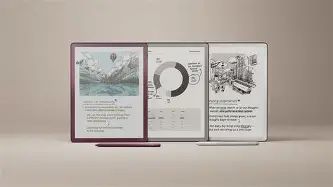
The device kept the familiar Scribe silhouette: thin-ish, grippy textured back, and a solid hinge-free slab feel that makes it comfortable to hold for long reading sessions. I appreciated the slightly textured Colorsoft display surface — it gives the stylus natural drag that mimics paper more closely than glossy tablets. The stylus attaches magnetically to the side and, in my experience, stayed in place most of the time (important when moving between rooms or tossing it in a backpack).
What I liked: the overall build feels durable and pleasant to handle. What bugged me: the ambient light sensor could be more consistent; sometimes the front light changed brightness at awkward moments during quick environment shifts. The included folio case is fine but a bit bulky; I ended up using a thinner sleeve for commuting.
Display and color: a useful step forward, with compromises
The headline feature is the Colorsoft color e-ink layer. In real use, color significantly improves diagrams, highlighted textbook pages, and comics — I could actually tell when a diagram used color to differentiate elements. Color is subtle and muted compared to LCD or OLED screens: don't expect vivid photos or saturated artwork. In my experience, the colors are most useful as visual cues rather than for aesthetic brilliance.
There are trade-offs. Color introduces slightly longer page refresh times and occasional dithering in gradients. When I flipped rapidly through a PDF with many colored pages, I noticed faint lag and momentary ghosting. For static content like textbooks, highlighted notes, or colored mind maps, the improvement over grayscale is meaningful. For photo editing or color-critical work, it’s not adequate.
Stylus and handwriting: comfortable, improved recognition, some quirks
The stylus is the part I used most. The nib provides a pleasant amount of friction on the screen and the pressure sensitivity felt natural for everyday handwriting. After a few firmware updates during my ownership, writing latency improved noticeably — strokes felt snappier and conversion accuracy for neat handwriting became better.
What I found was that the handwriting-to-text converter works well for tidy handwriting and for common vocabulary. When I rushed notes or used a lot of shorthand, conversion sometimes produced odd word substitutions and required manual corrections. Palm rejection is generally reliable, but I did have instances where my palm left a faint mark or the device registered accidental touch gestures when I rested my hand heavily on the screen during long note sessions.
Find top-rated Laptops & Computers products at great prices.
View Offers →Software, ecosystem, and cloud sync
Software is where the Scribe experience is distinctive. The reading and annotation flow is seamless with the Kindle book ecosystem: highlights and notes sync to the cloud, and I could access certain notes from other devices. The notebook feature is straightforward — create notebooks, add pages, export — and the addition of color-aware notebooks helped when I wanted to preserve highlighting schemes.
On the downside, file management still feels limited compared to a general-purpose tablet. The file browser is adequate but clumsy for organizing hundreds of PDFs. Tagging is basic and there isn't a deep folder metadata system. Third-party app support is nonexistent; you won't be running productivity apps, which is fine if you accept this as an e-reader/e-ink notebook hybrid, but limiting if you expected more versatility.
PDF handling and large documents
I work with multi-hundred-page PDFs frequently and the Scribe handled them acceptably. The device rendered large files and annotations correctly most of the time, but performance degraded with very dense technical PDFs (diagrams, embedded fonts, and heavy color). Page turns could take a beat, and zooming/panning was not as fluid as on an iPad. A practical workaround I developed was to split massive files into chapters and import them separately — not ideal, but it reduced lag.
Battery life and charging
Battery life is one of the Scribe’s strong suits. With my usage (daily reading plus regular note-taking and Wi-Fi sync), I typically saw about two to three weeks of battery life per charge. The device uses a slow-but-stable charge curve — I charged it every couple of weeks and occasionally left it unplugged for longer trips. If you use the backlight heavily and keep Wi-Fi active all the time, expect those numbers to dip; with lighter reading-only use, battery life stretches even further.
Longevity: scratches, durability, and firmware
After nine months there are no scratches on my display other than the unavoidable micro-nib marks from normal stylus use; the Colorsoft surface seems resilient and holds up to daily use. The device received a couple of firmware updates that meaningfully improved handwriting latency and fixed small UI bugs; that responsiveness from the manufacturer boosted my confidence in its long-term viability. That said, I still treat it as a single-purpose device and protect it from drops — it's a delicate screen even if the case is sturdy.
Price and value in 2026
When I bought it, I carefully weighed the cost against other note-first devices. For me, the price was justified because the Scribe replaced both an e-reader and a paper notebook. If you already own a tablet that handles note-taking well, the marginal benefit is less convincing. Value comes when you specifically want an e-ink device that reads for long stretches, supports handwriting well, and offers color cues for study materials.
Pros & Cons
- Pros:
- Excellent for long reading sessions — very low eye strain.
- Color e-ink adds meaningful value for textbooks, diagrams, and highlights.
- Comfortable stylus feel and improved handwriting latency after updates.
- Strong battery life in real-world use (weeks between charges).
- Seamless basic sync of highlights and notes into the cloud.
- Cons:
- Color is muted compared to LCD/OLED and not suitable for color-critical tasks.
- Software and file management are still limited compared to general-purpose tablets.
- PDFs with heavy graphics can be slow; large files may need splitting.
- Handwriting-to-text struggles with messy handwriting and shorthand.
- Lack of third-party apps and multimedia capabilities reduces versatility.
Comparison: Where the Kindle Scribe Colorsoft 2025 fits
Below is a quick comparison I made between the Colorsoft Scribe and two other devices I’ve used or evaluated. This table illustrates the intended use-cases rather than every technical detail.
| Device | Display | Color | Stylus | Battery | Best for |
|---|---|---|---|---|---|
| Kindle Scribe Colorsoft 2025 | Large e-ink (paperlike texture) | Muted color e-ink (good for diagrams) | Passive active stylus with pressure sensitivity | Weeks (typical mixed use) | Reading + note-taking, annotated textbooks, long battery life |
| reMarkable 2 | Large monochrome e-ink | No | High-latency-optimized pen (very natural feel) | Weeks | Pure note-taking, distraction-free writing |
| Tablet (e.g., iPad) | LCD/OLED, bright and vivid | Full color, high fidelity | Pressure-sensitive stylus (low latency) | Hours to a day | Multimedia, apps, productivity, color-accurate work |
Buying guide: what to check before you buy
1. Consider whether color e-ink fits your needs
If the main advantage you want is slightly better visuals for diagrams, textbooks, and color-coding, Colorsoft is helpful. If you need vivid photography or color grading, a tablet is a better pick. Ask yourself how often color actually matters in your daily reading and note workflows.
Find top-rated Laptops & Computers products at great prices.
View Offers →2. Test the stylus feel and conversion
Handwriting feel is subjective. If possible, try writing on a demo unit or a friend’s device. Check handwriting-to-text conversion on a few sample pages; if your notes are rushed or full of shorthand, conversion accuracy may degrade and you'll want to know how often you’ll need to correct output.
3. Size, storage, and file workflow
Decide how many large PDFs you’ll store. If your library includes many long annotated documents, choose the higher storage configuration or be prepared to manage files actively. Also map out how you want to export notes and whether the device’s export formats fit your workflow (PDF, PNG, handwriting-to-text exports).
4. Accessories and protection
Buy a case that protects the screen without adding too much bulk. If you sketch a lot, consider buying extra pen tips to replace worn nibs. A folio that doubles as a stand made my reading-with-notes posture much more comfortable.
5. Expect software trade-offs
Recognize you’re buying into a curated reading-and-note ecosystem rather than an open app platform. If you need email, third-party apps, or video, this isn’t the device for that. But if you want a focused, long-battery reading and note-taking experience, that's exactly what this device offers.
Final thoughts
After months of daily use, I can say the Kindle Scribe Colorsoft 2025 has become my go-to device for study, research, and long-form reading. The addition of color is genuinely useful for certain tasks and elevates the Scribe from a purely monochrome reader to a more versatile study companion. I appreciated the strong battery life, improved handwriting responsiveness after firmware updates, and the tactile pen feel.
Still, it’s not a perfect all-in-one. Color is modest, not vivid; the software limits how deeply you can organize and manipulate files; and some heavy PDFs push the device to its limits. For that reason, I view it as an upgraded e-ink notebook and reader rather than a replacement for a tablet. If you value focused reading and note-taking with occasional color cues, I found it to be a very satisfying purchase. If you need an app-rich, color-accurate, multimedia device, you'll likely be better served by a traditional tablet.
In my experience, the Kindle Scribe Colorsoft 2025 remains a compelling choice in 2026 for people who want to reduce screen fatigue, keep consolidated notes and annotated books, and enjoy long battery life — as long as they understand the device’s deliberate trade-offs.